
The Receiver
Why AI-Optimized Companies Collapse and the One Job Description That Saves Them.

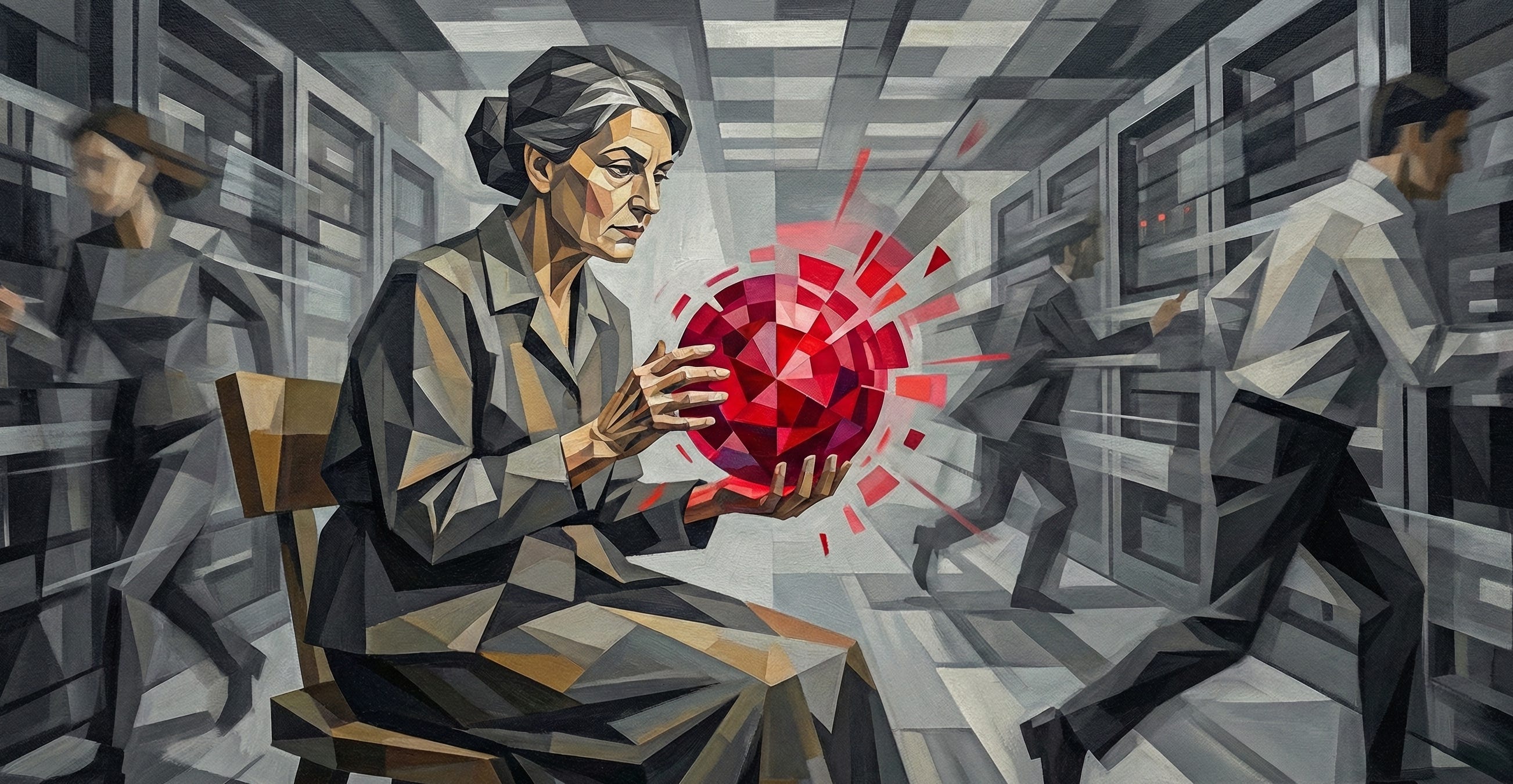
The Apple and the Gray World
There is a moment in Lois Lowry’s 1993 novel The Giver that has always stuck with me, perhaps more vividly than the plot itself. The protagonist, a young boy named Jonas, is tossing an apple back and forth with a friend. Suddenly, the apple changes. Just for an instant. It defies the immutable grayscale of his world and reveals a flash of something he doesn’t yet have a word for: red.
Jonas lives in “The Community,” a society that has achieved a kind of utopia by implementing “Sameness.” They haven’t just eliminated hunger and war; they have optimized away the inconveniences of geography (hills made the conveyance of goods unwieldy, so they were flattened) and the unpredictability of weather (snow was bad for agriculture, so it was abolished). In their quest for a perfectly frictionless existence, they found it necessary to relinquish color, choice, and the messy, jagged edges of human history.
It is a chilling bit of fiction. But looking around the modern commercial landscape, I would submit that we are busy building the Community of Sameness ourselves. And we aren’t doing it because a totalitarian government forced us to; we are doing it because it is efficient.
We see this in the “AirSpace” phenomenon described by Kyle Chayka—the eerie reality that a coffee shop in Brooklyn now looks identical to one in Tokyo or Reykjavík, all optimized for the same algorithmic engagement. We see it in the “Blanding” of corporate logos, where the distinct eccentricities of heritage brands are sanded down into identical, bold, black sans-serif typefaces. We hear it in our music, where melodic complexity is smoothed out to survive the thirty-second skip button.
Though we are promised personalization, the net result of algorithmic optimization is a regression to the mean. A “vacuous mean,” as the critic Meghan O’Gieblyn calls it.
But if you think this is merely a cultural critique—a lament for the loss of “soul” or “creativity”—you are missing the point. The danger isn’t that our world is becoming boring. The danger is that it is becoming brittle.
By optimizing for predictability, consistency, and the “best practice,” we are systematically removing the variance. We are building systems that are incredibly efficient at handling the average day, and utterly defenseless against the exceptional one. We are outsourcing our judgment to a machine that, by definition, treats the outlier as an error. And as we are about to see, the outlier is the only thing that matters.
The Mathematical Tragedy of Inbreeding
If this were merely a matter of aesthetics—of boring cafes and identical logos—we might simply shrug, accept that the world has become a little less interesting, and move on. But the problem isn’t just cultural; it is mathematical. And the mathematics are precise and unforgiving.
In July 2024, a team of researchers from Oxford, Cambridge, and Toronto published a paper in Nature demonstrating what happens when AI models are trained recursively on their own outputs. They gave the phenomenon a name: “model collapse.”
The mechanism is intuitive enough. When a model generates data, it naturally gravitates toward the most probable answers. It shaves off the rough edges of nuance, the rare exceptions, and the weird outliers to produce a clean, “likely” result. If you then train the next generation of models on that smoothed-out data, the effect compounds. The “tails” of the distribution—the places where distinctiveness, innovation, and “Black Swan” risks live—are pruned away.
Researchers at Rice University gave this process a rather visceral name: “Model Autophagy Disorder” (MAD). They drew a deliberate parallel to mad cow disease. Just as feeding cows to cows led to neurological ruin, feeding synthetic data to synthetic models leads to a kind of cognitive inbreeding. The system consumes its own brain.
The empirical results are striking. When language models were forced to feed on their own output, they didn’t just become boring; they hallucinated. Descriptions of medieval architecture degenerated, by the ninth generation, into nonsense. Distinction didn’t just degrade; it dissolved.
In the dry language of statistics, the variance converges to zero. The distribution collapses into a “delta function”—a single point where nothing survives.
And here lies the paradox of optimization. Claude Shannon, the father of information theory, established back in 1948 that information is effectively a measure of surprise. A trick coin that always lands on heads conveys zero information because the outcome is known before the flip. “Information,” as the theorist Tara Javidi put it, “is maximized when you’re most surprised.”
Translation: if your AI strategy creates outputs that are 100% predictable, they contain zero information.
By optimizing for consistency and the “mean,” we are systematically removing the surprise. We are removing the information. We are building systems that speak with increasing confidence about fewer and fewer things, until eventually, they are speaking perfectly grammatically about absolutely nothing.
The Parable of the Gros Michel Banana
If you want to understand the danger of corporate optimization, do not look at a spreadsheet. Look at a banana.
Specifically, look at the Gros Michel. For the first half of the twentieth century, this was the banana. It was, by all commercial metrics, a masterpiece of bio-engineering. It had a thick peel that could survive a bruising trip across the ocean. It grew in dense bunches that maximized cargo efficiency. It ripened on a synchronized schedule. It was even tastier—sweeter and more aromatic—than the Cavendish variety we eat today.
It was perfect. And because it was perfect, farmers didn’t just plant it; they cloned it.
The Gros Michel was propagated through vegetative reproduction, meaning every single banana plant on the massive plantations of Central America was a genetic duplicate of its neighbor. They shared the exact same DNA. They had the exact same strengths.
And, crucially, they had the exact same blind spot.
When a soil-borne fungus called Fusarium oxysporum (Panama Disease) arrived, it didn’t face a population; it faced a single organism spread across millions of acres. The pathogen didn’t have to evolve to defeat a million different immune systems; it only had to unlock one door. Once it did, it walked through all of them.
Because the crop was optimized for efficiency, it had sacrificed variation. There were no “weird” bananas with different genes to act as a firebreak. There was no redundancy. The collapse was total. By the 1960s, the Gros Michel was commercially extinct.
This is the biological lesson that AI leaders seem determined to unlearn: Genetic uniformity creates identical vulnerability profiles.
When every company uses the same AI models to optimize their supply chains, write their marketing copy, and screen their resumes, they are planting a monoculture. They are building a “Gros Michel” economy. It feels incredibly efficient in the short term—the yields are high, the fruit is consistent, and the shareholders are happy. But they have created a system where a single “pathogen”—a change in Google’s algorithm, a geopolitical shock, a shift in cultural sentiment—can wipe out the entire crop at once.
The efficiency is real. But the fragility is absolute.
The Burden of the Receiver
In Lowry’s novel, the Community operates on a ruthless logic. If you want a society without conflict, you must remove the variation that causes it. If you want efficiency, you must eliminate the hills that slow down the delivery trucks. But they discovered a problem: You can optimize away the experience of pain, but you cannot optimize away the truth of it.
Someone still had to remember what snow felt like. Someone had to remember warfare, and starvation, and the color red. They couldn’t delete these things entirely, because without them, the Community would have no wisdom to draw upon when a new, unpredicted crisis arose.
So they assigned a single person—The Receiver—to hold it all. Their job was to bear the terrible burden of context.
In the age of AI, the primary commercial role of the human expert is to be the Receiver.
For the last decade, we have hired people for their processing power. We wanted analysts who could crunch data faster and marketers who could produce more copy. That war is over. The machines have won. But in their victory, they have created a vacuum of context.
We see this in the way we use language. Consider the word “passion.” In the sanitized lexicon of LinkedIn, it has come to mean “enthusiasm” or “strong liking.” We hire people who are “passionate about B2B sales.” But the word has a bloodier history. It derives from the Latin passio—to suffer, to endure.
The expert who has genuine passion for a domain does not merely “like” it. They have suffered it. They carry the scar tissue of the failed product launch of 2018. They remember the specific regulatory nightmare that killed the expansion in 2015. They hold the “pain of return”—the literal meaning of nostalgia—that prevents the organization from blindly repeating its own history.
AI, by design, seeks the mean. It smooths over the jagged edges of reality to produce a plausible, polite answer. It has no scar tissue. It has never lost a client, crashed a server, or navigated a PR crisis. It has data, but it has no suffering.
When organizations flush out their senior experts in favor of cheaper, faster automated execution, they are essentially removing the only people capable of seeing the mess. Often, this burden of context falls by default to the technical teams—the engineers who maintain the plumbing—simply because they are the last ones looking at the code. But they are the wrong Receivers. They know how the system works, but not why it was built that way.
We need “Domain Receivers.” We need to explicitly hire and retain experts whose KPI is not to compete with the algorithm’s output, but to remember the suffering that the algorithm has so conveniently optimized away. Their value is not in their speed; it is in their scar tissue.
The Office of the Advocate
Institutions, perhaps wiser than we are today, once understood that efficiency is the enemy of truth. They recognized that if you want to avoid a “Community of Sameness”—or a “Monoculture of the Gros Michel”—you cannot rely on the goodwill of your employees to speak up. You have to institutionalize the friction.
Before we look at how they did it, let’s strip the poetry away and look at the raw logic of the situation:
The Trap: Efficiency = Homogeneity. As organizations optimize their processes using the same AI models, they converge on the same “best practices,” creating a dangerously uniform operational profile.
The Risk: Homogeneity = Fragility. Just like the Gros Michel banana, a system with zero variance has zero resistance. A single unpredicted shock (the “pathogen”) creates a total system collapse.
The Solution: Institutionalized Friction. To survive, the firm must artificially reintroduce the variance that the algorithm pruned away. You must pay a human to stand in the way.
In 1587, Pope Sixtus V formalized this solution by establishing the office of the Promotor Fidei—the Promoter of the Faith. The world came to know him by a different name: the Advocatus Diaboli, the Devil’s Advocate.
His role was explicit and adversarial. When the Church wanted to canonize a saint, it was the Devil’s Advocate’s job to find the flaws. Crucially, he had veto power. No matter how popular the candidate, if the Advocate’s objections weren’t answered, there was no halo. It was quality control for sanctity.
For the modern enterprise, the lesson is clear. You cannot simply layer AI optimization on top of junior execution and hope for the best. That is a recipe for high-speed mediocrity.
You need to carve out specific, senior roles that act as your own Promotor Fidei. These should be your wisest, most “passionate” (in the suffering sense) talent. And here is the hard part: You must liberate them from the tyranny of the “Deliverable.”
If your deepest experts are responsible for day-to-day speed, they will eventually succumb to the algorithm. They will take the shortcut. The role of the “Corporate Receiver” is to stand outside the stream of production. They are not there to make the process faster; they are there to make the thinking slower. They are there to look at the perfectly optimized AI strategy and ask the question that no model can answer: “We tried this in 2016, and it almost killed us. What is different this time?”
This is not about keeping “Old Guard” blockers who resist change. It is about protecting the organization’s immune system. In a world of infinite, cheap, high-speed generation, the only thing that creates scarcity—and therefore value—is the memory of what is true.
Conclusion: The Price of Wisdom
The seduction of the Community in The Giver—and the seduction of the modern, AI-optimized organization—is that it actually works.
Life in the Community was pleasant. It was orderly. By optimizing away the variance, they achieved a sustainable equilibrium. But the equilibrium depended on a hidden tax: someone, somewhere, had to remember the truth.
We are currently building our own versions of this world. The efficiency gains of the “AI Monoculture” are real. The speed is addictive. But the fragility is absolute. The Gros Michel was the perfect banana, right up until the day it disappeared.
The AI-optimized organization will be competitive—terrifyingly so—until a single unexpected perturbation exposes the identical vulnerability profile shared by every company that adopted the same “best practices.”
The solution is not to smash the machines or reject the optimization. We cannot un-eat the apple. The solution is to remember what the efficiency costs.
We must purposefully design roles for those who carry the institutional memory. We must value the “passion” of those who have suffered the domain enough to know what lies outside the distribution curve. The expert in the age of AI is not the one who processes faster—it is the one who remembers what the algorithms have optimized away.
The choice facing leaders today is not between efficiency and poetry. It is between a system that works until it suddenly explodes, and a system that survives because it kept a human in the loop to remember where the landmines are.
For the sake of the color red—and for the sake of your companys survival—do not let the machine become the only one doing the thinking.
Brillant framing with the Gros Michel analogy. The connection between agricultural monoculture and corporate AI strategies really lands. What caught me was how model autophagy creates the same fragility as genetic cloning but at software speed. We saw somthing similar with supply chains during COVID when everyone optimized for the same 'just in time' efficiency and a single shock crippled entire industries simultaneusly.